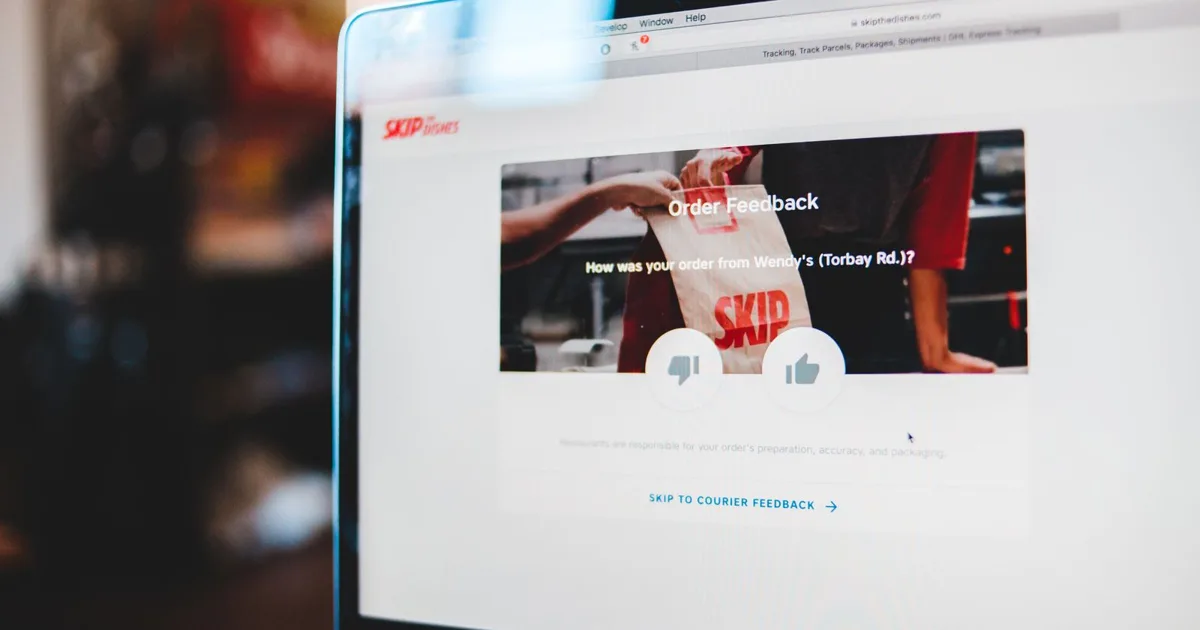
In 2023, a person was exposed to between 6,000 and 10,000 promotional messages a day (source: Frictionless Commerce).
A number that says everything about consumer attention fatigue!
In this world of ad overload, capturing customers' attention is already hard… and keeping them loyal is even harder.
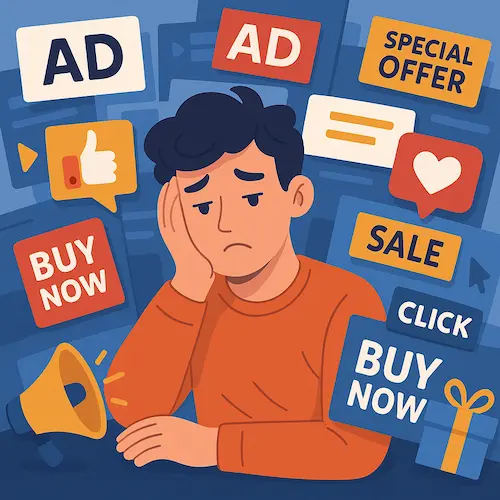
Businesses are seeing it firsthand: classic customer relationship methods are no longer enough (reviews declining, satisfaction dropping, customer acquisition costs rising).
What if gamification were the answer to capturing attention, driving action and building lasting customer loyalty?
👉 In this article, discover why gamification works so well, 5 concrete mechanics to put in place, and how to build it into your relationship strategy in 4 steps.
Not a game, a behavioral lever
Gamification is not about "making customers play" in a purely fun sense!
It is the application of mechanics borrowed from games (points, challenges, levels, rewards…) to business and revenue-driving contexts.
Done right, it helps lock in strategic behaviors at the right moment in the customer journey:
- leaving a review,
- coming back to the store,
- referring a friend,
- signing up for a loyalty program.
👉 Gamification introduces micro-motivations where engagement is usually low.
It works well alongside a broader relationship-marketing strategy by driving action instead of passively asking for it. It also pairs nicely with other loyalty actions that bring customers back to your store.
Why does it work? (dopamine, reward, immediate feedback)
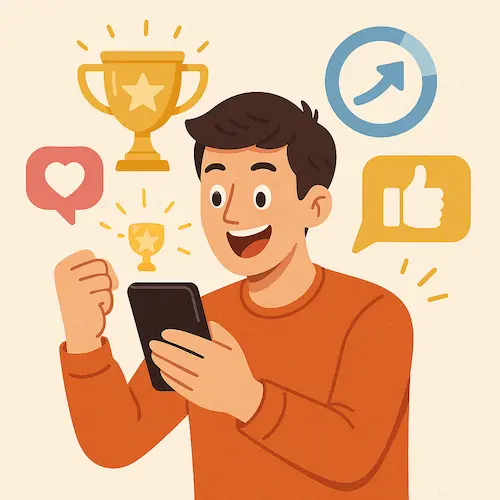
What makes gamification so powerful for customer engagement is that it activates fundamental psychological mechanisms:
- Dopamine, triggered by the anticipation of a reward,
- Immediate feedback,
- A sense of progress.
These mechanisms turn a "utilitarian" action (like leaving a review) into a rewarding customer experience.
👉 It stops being a simple nudge… and becomes a valuable trade-off, an immediate benefit for the loyal customer.
Gamification is not a futuristic idea
Your existing customers already experience it… often without even realizing it:
- Airline loyalty programs (miles): points earned, elite status, exclusive rewards,
- Loyalty badges at Starbucks, Decathlon or Sephora,
- Customer challenges like "come back 5 times this month to unlock an offer."
These mechanics work because they are simple, quick to understand… and they build a lasting relationship with the brand.
So, how do you apply these mechanics to your own loyalty strategy?
👉 Here are 5 gamification mechanics to put in place in your business to boost engagement and build customer loyalty.
5 gamification mechanics for customer loyalty
These mechanics apply to any business. The goal stays the same: find the ones that best serve your loyalty strategy.
| # | Mechanic | How it works | Concrete example | Goal |
|---|---|---|---|---|
| 1 | Loyalty points & status | Earn points, unlock tiers and a status level | A perk unlocked at each tier (free shipping, badge) | Steady long-term engagement |
| 2 | Recurring challenges | Repeat an action within a limited time | "Come back 3 times in 30 days" | Increase visit frequency |
| 3 | Surprise rewards | The customer knows they will win, but not what | Mystery box after a purchase | Curiosity & emotional attachment |
| 4 | Gamified referrals | Progression through badges and tiers | "Explorer" badge, "Ambassador" level | Turn the customer into an acquisition channel |
| 5 | In-store prize games | Scan, leave a review, play instantly | Spin-to-win wheel via QR code (100% winning) | Collect reviews & drive foot traffic |
1. Loyalty points or status systems
Loyalty points are a classic… but gamification gives them fresh momentum.
The customer sees their efforts rewarded in real time… and feels valued!
Example: every purchase, referral or review earns points. At certain tiers, the customer unlocks a perk: free shipping, an exclusive offer, a status badge…
The goal is to encourage regular customer engagement and strengthen loyalty over the long run.
2. Recurring challenges ("come back 3 times in 30 days")
Inspired by fitness apps and video games, customer challenges create short-lived tension that still drives engagement.
👉 The principle? Repeat an action within a limited time to complete a mini-challenge.
Concrete examples:
- Come back to the store 3 times in 30 days.
- Post 2 reviews within a week.
- Invite 1 friend before Sunday.
The goal? Increase contact frequency, build closeness with your customers, and keep the experience lively day to day.
3. Surprise rewards (loot box, mystery box)
The principle is simple: the customer knows they will win, but not what.
That element of mystery sparks curiosity, triggers a positive emotion… and makes the interaction more memorable.
👉 Goal: get the customer playing, involve them in the reward mechanic, and trigger:
- anticipation (what will I win?),
- the pleasure of taking part,
- and an emotional bond with your brand.
Examples:
- Instant draw after signing up for a newsletter
- Free mystery box after an online purchase
- Random reward after a referral
4. Gamified referrals (badges, tiers, cumulative rewards)
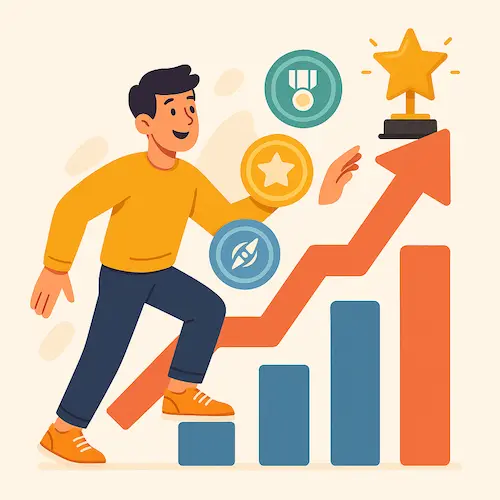
Customer referrals are already powerful on their own, but gamification can make them even more engaging by introducing a sense of progression.
👉 The more a customer refers others, the further they move through a relationship program with cumulative rewards.
Progression examples:
- "Explorer" badge from the first referral.
- "Ambassador" level after 5 referrals.
- Cumulative rewards at each tier.
The goal? Turn the customer into an active part of your acquisition, while strengthening their relationship with you and your brand.
The referrer becomes a prospecting tool that also strengthens the loyalty of your existing customers.
5. In-store prize games (spin-to-win wheel, scratch cards)
In a physical setting (shop, restaurant, salon, trade show booth…), visual prize games like a spin-to-win wheel are an excellent way to engage customers at the right moment.
While waiting, right after a purchase, at delivery or on the way out… any moment becomes an opportunity, as long as the mechanic is fast, visual and frictionless.
How it works in practice:
- The customer scans a QR code
- They leave a Google review or follow your social media (or take another action)
- They play instantly for a chance to win a reward
100% winning games are far more effective than games where you can lose (players always leave with something, which reinforces their satisfaction).
For more on this specific mechanic, discover how a spin-to-win wheel game earns 5x more Google reviews.
At Up Review, our client Polygone Montpellier ran this exact mechanic during a seasonal sales period and collected over 601 reviews in just 10 days.
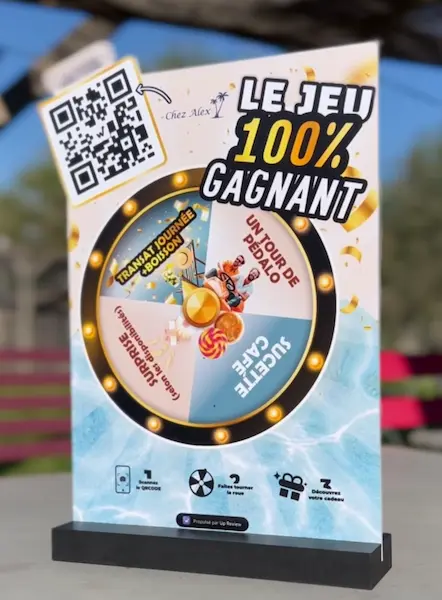
👉 [Launch a prize game with Up Review and build customer loyalty through gamification]
The benefits:
- Collect more customer reviews or trigger a strategic action (follow, opt-in, referral…).
- Create activity and drive foot traffic in-store.
- Build a positive memory and encourage repeat visits.
Pairing this mechanic with a reward to redeem later (a time-limited offer) multiplies the chances of a repeat purchase!
As you can see, gamification adds real value on the acquisition side.
So… what really sets it apart from traditional loyalty techniques?
What gamification really adds
Gamification is not just entertainment: it affects retention, repeat purchases and even customer insight.
Better retention and repeat purchases
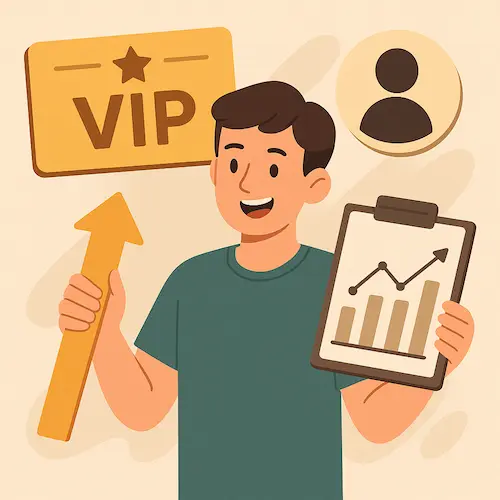
By creating progression, anticipation of a reward or a symbolic attachment (VIP status, badge…), gamification builds emotional loyalty.
👉 Customers no longer come back just for a promotion, but to PROGRESS within a relationship system.
The long-term effects:
- lower churn rate,
- better customer lifetime value (LTV),
- higher retention rate.
According to Capgemini, brands that build a strong emotional connection can increase revenue by 5% and see 70% of emotionally engaged customers ready to spend twice as much on their products.
Better customer insight
Every action within a game mechanic becomes valuable data: participation, response time, preferences, reactivity to the reward…
By connecting this data to your marketing CRM or your customer relationship management (CRM) tool, you improve:
- your customer segmentation,
- the personalization of your campaigns,
- and your understanding of what drives engagement.
👉 Gamification then becomes an analytics lever, supporting a more targeted loyalty strategy.
Interesting, right?
Now let's see how to put it in place step by step.
Integrating gamification into your customer loyalty strategy in 4 steps
Step 1: Attract your customers with a simple game, at the right moment
For gamification to have a real impact, it has to happen at the right moment in the customer lifecycle.
👉 These moments of friction or drop-off (waiting, checkout, delivery…) are all opportunities to re-engage customers with a playful action.
Next, success comes from simplicity: a good gamification mechanic should be understood in under 5 seconds, on any channel. The user needs to instantly know:
- what they need to do,
- what they can win,
- and why it's worth it.
That is why the spin-to-win wheel and scratch card work so well:
- Formats accessible everywhere: a QR code on a flyer, a touchscreen kiosk in-store, a link on social media… every touchpoint becomes a chance to play.
- Ultra-fast participation: in under 30 seconds, the customer plays and wins, with zero friction.
- Data collection: email, phone number, date of birth… all gathered easily, in exchange for a moment of fun.
👉 Digital tools should serve engagement, not complicate it.
Step 2: Create a memorable customer experience
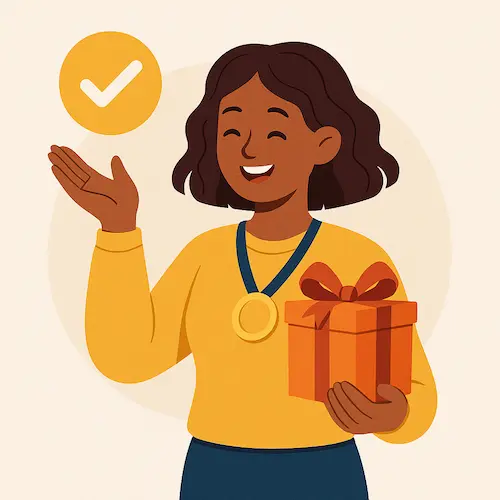
A good game does more than attract: it has to earn the participation.
You do not need a huge discount: a reward perceived as useful, exclusive or personalized is enough. What matters is the emotional trigger behind the gift:
- feeling valued,
- receiving a legitimate trade-off,
- feeling anticipated.
To turn the game into a magnet for prospects:
- Customize the visuals to match your brand identity.
- Add sound and visual animations to capture attention.
- Include a call to action: "Leave a review," "Join our VIP program," "Follow us on Instagram."
A GatherUp report (September 2024) shows that businesses that actively ask for a review collect an average of 122 reviews per location, compared to 53 for those that do not.
👉 In short: asking increases review volume by +130%!
Step 3: Re-engage automatically by SMS and email
The follow-up after the interaction turns a player into a loyal customer. To keep the connection alive, you need relevant, well-targeted messages synced with the customer journey:
- An immediate thank-you SMS after the game, for example with a personalized offer to extend the experience.
- Automatic emails at day 1 or day 2 to re-engage contacts while the memory of the game is still fresh.
- Behavior-based messages: differentiated offers based on the prize won, how often the customer plays, or the data collected.
According to a study published by TechJury in 2024, SMS marketing achieves a 98% open rate, with 90% of messages read within 3 minutes of being sent.
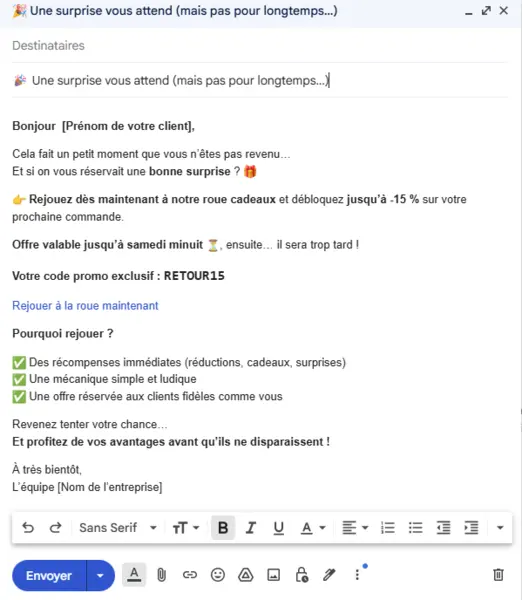
A concrete example from Up Review: an email sent 45 days after a user discovers the tool, designed to convert an inactive user into a paying subscriber. It checks every box: a clear, time-limited offer, a visible promo code, concrete benefits and a friendly tone.
Step 4: Build a lasting relationship program and track it
Once your customers are attracted, engaged and re-engaged, the goal is to keep them loyal over the long term. The foundations of an effective relationship program:
- Centralize everything in a CRM: every game, purchase or follow-up is logged to better track the customer journey.
- Reward loyalty: the more a customer plays or interacts, the more perks they earn.
- Target by profile: regular customers, new customers and partners get differentiated offers.
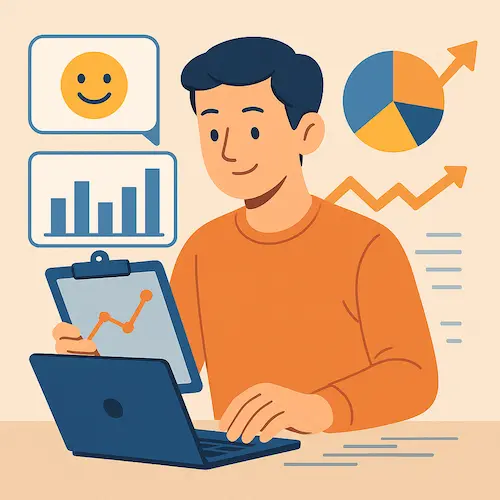
And like any customer retention strategy, it relies on data tracked over time. Connect your metrics to your CRM tool to follow key KPIs such as:
- participation rate,
- volume of customer reviews generated,
- frequency of interactions,
- reactivation rate,
- perceived satisfaction level.
This data-driven approach helps you keep your customers and grow the loyalty of your best customers.
Conclusion: gamification, the starting point of customer loyalty
Well-designed gamification is not a gimmick or a one-off stunt.
It is the starting point of your relationship strategy, built on customer value and closeness with your customers.
So why not get started today?
👉 [Launch an Up Review prize game today and build customer loyalty]
or