
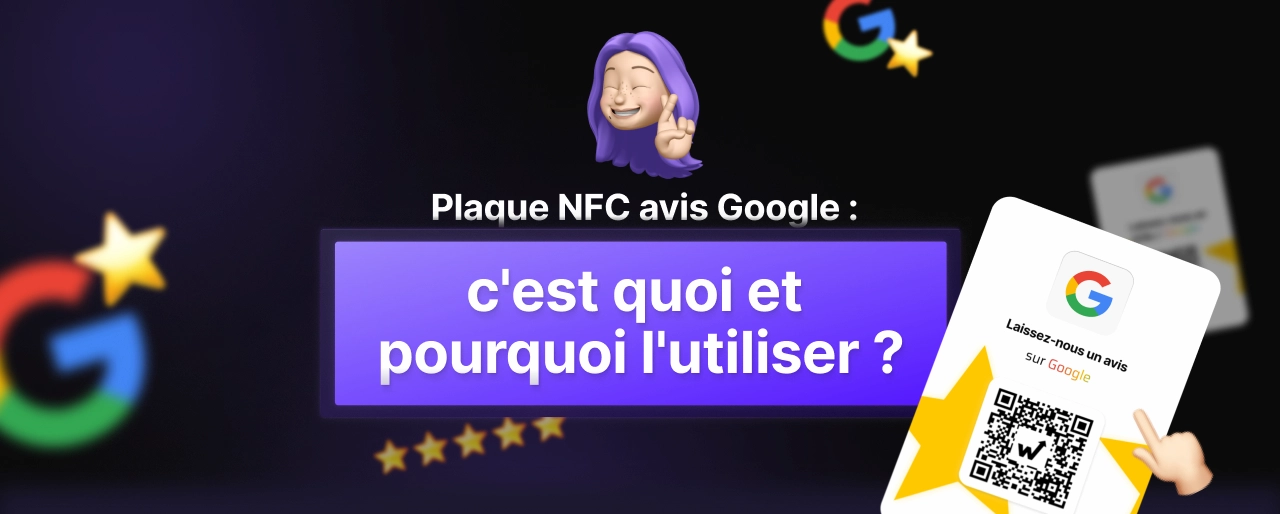
An NFC Google review card holds a small chip that stores your Google review link. A customer taps it with an iPhone or an Android phone and the review form opens, with no app, no camera and no search. It is the shortest path between "thank you, could you leave us a review?" and a published review, and it costs between $5 and $50 depending on the format.
Why bother: in the BrightLocal 2026 survey, 97% of consumers read reviews for local businesses and 68% require four stars or more. Google lists "review count and ratings" among the signals of prominence in its local ranking guidance. Most reviews are lost not because customers refuse, but because the ask arrives too late or takes too many steps. The tap removes the steps.
How the card works
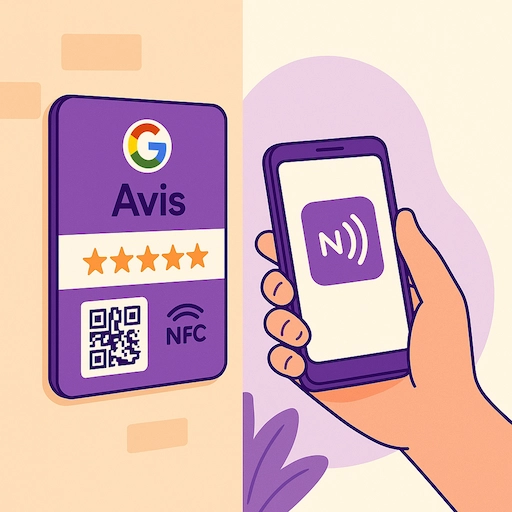
- The chip. A passive NFC tag, the same technology as contactless payment, with no battery. It stores a single piece of data: your Google review URL.
- The tap. The customer holds the phone within a couple of centimeters. iPhones read NFC tags in the background; Android phones do the same when NFC is on. The phone shows a notification and opens the link in the browser.
- The form. The link lands directly on the "write a review" form of your Google Business Profile, signed in with the customer's Google account.
- The fallback. A printed QR code covers phones without NFC and customers who prefer to scan. Our guide to Google review QR codes shows how to generate one; the link itself comes from your profile, see how to create your Google review link.
QRCodeChimp describes the two families of products: a review card (QR code, NFC chip or both, with your logo and a short message) and a tap tag (a smaller NFC sticker or tag for a table, a counter or a display). It also notes a practical rule for self-programmed tags: write the link with an app such as NFC Tools, test, and lock only when the link is right, since a locked tag cannot be edited.
Card, plate, stand or sticker: which format where
| Format | Where it lives | Best for | Watch out for |
|---|---|---|---|
| Card (credit-card size) | In a staff member's pocket or on the check tray | Restaurants, salons, services where a person hands it over | Needs a human to present it |
| Counter plate | Flat on the counter, next to the card reader | Bakeries, cafés, retail checkouts | Keep it clean and facing the customer |
| Stand (acrylic, upright) | Reception desk, host stand, bar | Hotels, clinics, bars | Height matters: the phone must reach the chip |
| Sticker or tag | Tables, windows, menus, packaging | Cafés with table service, takeout | Harder to test, easy to forget when a link changes |
Where to place it
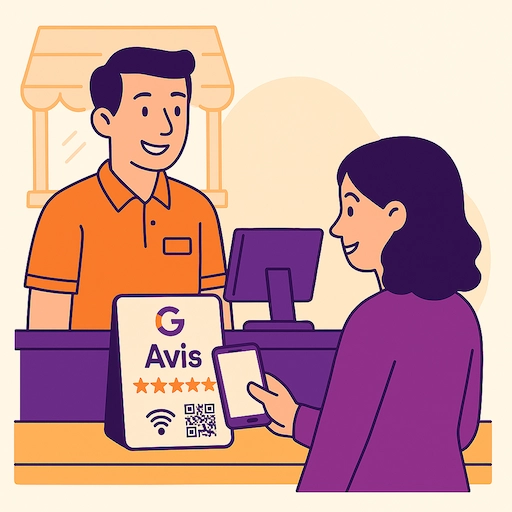
The right spot is where the customer has a free hand and a few seconds: the payment terminal, the reception desk, the end of the bar, the table after the bill. A plate behind the counter, out of reach, collects nothing. For a business with several locations, each plate carries that location's link; a plate pointing to the wrong profile sends reviews to the wrong place, so test every plate after setup.
What to say when the customer is in front of it
The tap is mechanical; the ask is human. Three lines that work:
- "If you have thirty seconds, a tap here opens our Google reviews. It helps us a lot."
- "Everything good today? A review helps the next customer find us."
- For a prize mechanic: "Leave us a review, then spin the wheel, everyone wins something."
Staff who show the plate collect several times more reviews than a plate left alone. Our guide on encouraging customers to leave a review gives more scripts.
The rules on rewards
A thank-you gift is allowed; a gift for a five-star review is not. The FTC consumer reviews rule (16 CFR Part 465, 2024) prohibits incentives "conditioned on the writing of consumer reviews expressing a particular sentiment". In the UK, Schedule 20 of the DMCC Act 2024 bans concealed incentivized reviews. Google's own policy prohibits gating (asking only happy customers). The compliant setup: offer the same mechanic to every customer, make the reward independent of the rating, and say so on the plate or the screen.
Prices in the US, the UK and from Up Review
Read on November 3, 2026:
- US marketplaces. Walmart listings for QR and NFC review stands ranged from about $15.99 to $49.99; plain NFC review cards were listed from about $5 each and four-packs around $19.99 on US marketplaces the same day. These are listing prices from third-party sellers and change often.
- Up Review shop. The connected card is 19.99 EUR excl. VAT (down from 24.99), the counter plate 29.99 EUR excl. VAT (down from 39.99) and the premium card 32.99 EUR excl. VAT. Each one combines NFC and a QR code, works on iPhone and Android, is set up in under ten seconds after delivery, and can point to six destinations (Google, Instagram, TikTok, Tripadvisor, Trustpilot, WhatsApp) that you can change later without reprinting. No subscription is required for the card.
One limit to know before ordering from Up Review: the shop page lists delivery to mainland France, Belgium, Switzerland, Luxembourg and Monaco. If you are in the US or the UK, ask about delivery during the demo rather than assuming it.
NFC, QR code or prize wheel: use all three
They do not compete. The NFC tap is the fastest path for customers who are already willing. The QR code catches the rest. The review contest adds a reason to act for the customers who would otherwise say "later": they leave a review, then spin a prize wheel open to everyone, and their contact details join your customer base for SMS and email campaigns. Up Review clients who run the contest collect around 200 additional Google reviews per month on average; Izard Café Central, a brasserie, went from 1,285 to 2,985 reviews and from 4.0 to 4.5 stars with the plate at the counter and the contest.
Setup checklist
- Create your Google review link from your Business Profile.
- Choose the format for the spot where customers wait.
- Program the tag (or order it programmed) and test on an iPhone and an Android phone.
- Print a QR code next to the chip.
- Brief the staff with one sentence to say.
- Reply to every review within 48 hours; our examples of replies to negative reviews help with the hard ones.
- Check the review count monthly. If it does not move, the plate is in the wrong place or nobody mentions it.
See the plate, the wheel and the replies on your own profile
Book a 30-minute demo: we show the NFC plate and the review contest at the counter, the AI replies, and the price for your business.