
Google, Yelp, OpenTable, DoorDash… These names are already part of your daily life as a restaurant owner in the US or UK. In 2026, these platforms no longer just help you get noticed.
They are genuine growth levers to increase your local visibility, attract new customers and effectively list your restaurant online.
Why list your restaurant on the right platforms?
According to BrightLocal's 2026 Local Consumer Review Survey, 97% of consumers read reviews for local businesses before choosing one.
Having a website is essential, but showing up on Google, on the review sites your guests actually check, and on the booking or delivery app that fits how you serve customers matters just as much.
A well-optimized Google Business Profile listing attracts traffic. It boosts your conversion rate and makes you more visible on Google.
The better you're listed, the more customers choose you. But more platforms isn't automatically better: a directory or delivery app that barely operates in your market adds nothing but clutter. This guide sticks to the platforms that actually move the needle for a restaurant in the US or UK.
👉 Listing your restaurant on the right local, review, booking and delivery platforms lets you:
- send positive signals to Google's algorithms
- boost your local SEO
- multiply your points of contact with potential customers
- outperform your competitors
- collect qualified leads, reservations and orders
The 11 platforms that matter for a US or UK restaurant, at a glance
| # | Platform | Category | Best for | Cost to join |
|---|---|---|---|---|
| 1 | Google Business Profile | Directory / Maps | Every restaurant (essential) | Free |
| 2 | Yelp for Business | Reviews / Directory | Reviews and local discovery | Free, paid ads optional |
| 3 | Tripadvisor | Reviews / Tourism | Tourists and international travelers | Free, paid Business Advantage optional |
| 4 | Social / Reviews | Community, events, local ads | Free | |
| 5 | Apple Business Connect | Directory / Maps (iOS) | iPhone users, Siri search | Free |
| 6 | Better Business Bureau | Trust / Directory | Consumer trust signal | Free profile, paid Accreditation optional |
| 7 | OpenTable | Reservations | Automated bookings, guest CRM | Subscription (contact sales) |
| 8 | Resy | Reservations | Fine dining, big cities, Amex diners | Subscription (contact sales) |
| 9 | DoorDash | Delivery / Pickup | Delivery-first restaurants | Free to join, 6 to 30% commission |
| 10 | Uber Eats | Delivery / Pickup | Reaching Uber's delivery audience | Free to join, commission per order |
| 11 | Grubhub | Delivery / Pickup | No long-term contract, own-site ordering | Free to join, commission per order |
Up Review is not on this list on purpose: it isn't a directory. It's the tool that helps you turn the reviews these platforms bring in into more 5-star ratings, more on that further down.
Where to list your restaurant and attract more customers
1) Google Business Profile
Google My Business is now called Google Business Profile, and it remains the single most important listing for a restaurant, whether you're in the US, the UK or anywhere else.
It's often the first point of contact between your restaurant and future customers: listing, photos, reviews, directions, hours… it all starts here.
Through your free profile, you can add appealing photos of your food and dining room, respond to customer reviews, publish updates and special offers, let guests book a table with Reserve with Google or order delivery and takeout through a linked partner, and update your key information (hours, menu, phone number) whenever it changes.
Why this matters so much: Google Search and Google Maps are where most diners start when they look for a place to eat nearby.
👉 Claim or create your free profile at google.com/business, verify it, then keep it complete and active: it's still the biggest factor in reaching the local Top 3, where most clicks, calls and bookings happen.
👉 10 tips to optimize your restaurant's Google Business Profile
2) Yelp for Business
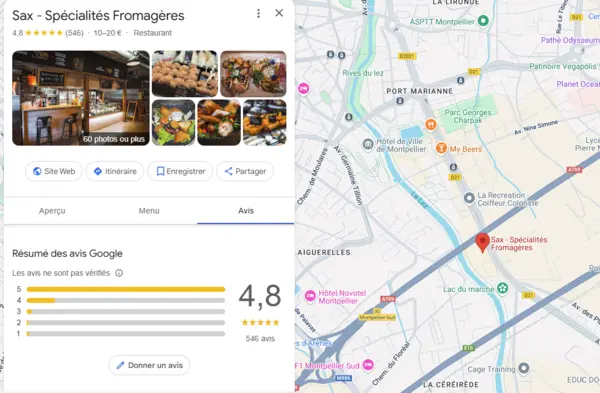
Yelp is one of the biggest names in customer reviews in the US, and it remains influential in many UK cities too. Around 2.4 million people visit Yelp every day, and 82% of users hire or buy from a business they found there within a week (Yelp for Business).
Claiming your page is free: search for your restaurant at biz.yelp.com/claim, verify it by phone, text or email, and most pages are approved within 24 hours. Once claimed, you can update your hours, menu and photos, and respond directly to reviews.
Paid options exist if you want to go further: Yelp Ads for extra visibility, or Yelp Guest Manager for reservations and waitlists.
A complete, actively managed Yelp page is a strong complement to Google Business Profile, especially for restaurants that rely on local discovery and word of mouth.

3) Tripadvisor
Tripadvisor is one of the most visited travel platforms in the world and a must if tourists are part of your customer base. Its community has published more than a billion reviews and opinions (Tripadvisor), and Tripadvisor pages are also very well ranked on Google, which strengthens your visibility for searches like "best Italian restaurant in London."
Claiming your listing is free: go to Tripadvisor for Business, search for your restaurant, and verify that you're the owner. From there you can update your description, menu, photos and contact details, and respond to every review.
A paid Business Advantage subscription adds a featured review, a photo and video carousel, tap-to-call, and clickable special offers.
👉 Take the time to maintain your profile, encourage guests to leave reviews and reply to every one: it remains one of the most effective ways to build your online reputation with an international audience.
4) Facebook
A Facebook Page is still one of the easiest ways to build a community around your restaurant. Meta's family of apps, including Facebook, reaches 3.60 billion people a day (Meta, Q2 2026 results), which makes it one of the largest local audiences you can reach for free.
On your Page, you can publish your menu, photos and events, let guests message you directly to ask questions or book a table, collect recommendations from past customers, and run targeted local ad campaigns when you want an extra push, for a launch, a new menu or a slow week.
Creating a Page costs nothing: go to facebook.com/business/pages, choose the Business or Brand type, add your details and publish.
5) Apple Business Connect
Apple Business Connect lets you manage your restaurant's place card on Apple Maps, and it reaches more than a billion Apple users across Maps, Messages, Wallet and Siri (Apple Newsroom).
Your place card carries your name, address, phone number, hours, category, photos and a short description, plus Showcases, Apple's version of Google Posts, for seasonal menus, offers and announcements. You can also link directly to reservation or ordering partners such as OpenTable.
It's free: sign in or create an Apple ID at businessconnect.apple.com, let Apple verify your business, then claim your location and customize your card.
Your presence there matters most in areas with a strong iPhone user base, where guests search for restaurants through Siri or tap directions straight from Maps.
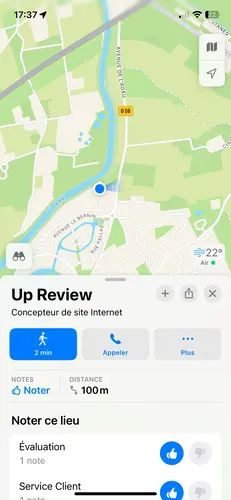
6) Better Business Bureau (BBB)
The Better Business Bureau publishes a free Business Profile for most US and Canadian businesses, showing your rating, customer reviews and complaint history. It costs nothing to claim and adds a trust signal that's well known to American consumers.
Paid BBB Accreditation goes further: it requires at least six months in business and annual dues that generally run from around $500 to just over $1,000 depending on your size, and in return you get the BBB seal, a customizable profile and access to dispute resolution. More than 400,000 businesses across the US and Canada are currently BBB Accredited.
For most independent restaurants, claiming the free profile is worth the ten minutes it takes. Paid Accreditation matters more when trust is a bigger barrier to a first visit, for instance for a new restaurant still building a track record in its neighborhood.
Turning your listings into 5-star Google reviews: Up Review
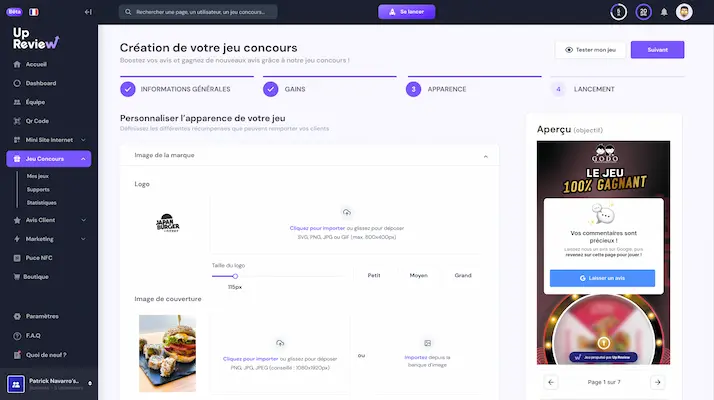
Being listed everywhere is only half the job. The other half is making sure the reviews that pile up on those listings, starting with Google, are good ones, and that you actually have time to answer them. That's where Up Review comes in.
Up Review isn't a directory: it won't get your restaurant listed anywhere. It's a review generation and reputation management platform that plugs into the Google Business Profile you already claimed, and turns everyday visits into 5-star Google reviews.
We have seen this play out with our client Quick Avignon/Nimes: across its 3 restaurants, the average Google rating climbed from 2.3 to 4 once the review-collection loop replaced word of mouth as the main source of new reviews.
With Up Review, you can:
- Turn table visits into Google reviews with a gamified prize wheel, played through a QR code or an NFC plaque at the counter or on the receipt. Restaurants running this loop generate around 200 extra Google reviews a month on average.
- Let AI draft a reply to every Google review in under 3 seconds, then validate it yourself or switch to full automation.
- Centralize every Google review in one dashboard instead of checking your listing manually.
- Build a customer database from each scan (name, email, phone, birthday) and follow up by SMS to bring guests back.
👉 See how Up Review manages your Google reviews
Reservations and bookings: filling your tables
7) OpenTable
OpenTable runs a global network of more than 60,000 restaurants (OpenTable, State of the Industry), and it's one of the most established reservation platforms in both the US and the UK.
Beyond the booking widget for your own website, OpenTable gives you a guest CRM (visit history, preferences, VIP tags), waitlist management for walk-ins, and a listing on OpenTable's own diner-facing site and app, where reviews and availability drive new bookings.
Sign-up runs through the OpenTable Restaurant Solutions page: a representative helps you choose a plan and get the reservation widget live on your site.
It suits most full-service restaurants that want to automate bookings and reach diners who are already searching OpenTable for a table.
8) Resy
Resy has built a strong reputation in fine dining and major cities, from New York and Los Angeles to a growing presence in London. It has been owned by American Express since 2019.
Through American Express Global Dining Access, Amex Card Members get priority reservations and access to exclusive events at Resy restaurants (American Express), which puts your restaurant in front of a high-spending, card-carrying audience.
To join, apply through resy.com/for-restaurants; onboarding is sales-assisted, and Resy's team helps set up your reservation book.
Resy is worth prioritizing if your restaurant is full-service, higher-end, or based in a city where Resy already has a strong footprint. Many restaurants run OpenTable and Resy side by side.
Delivery and takeout: reaching customers who order in

9) DoorDash
DoorDash is the largest food delivery marketplace in the US by order volume, ahead of Uber Eats and Grubhub (Statista).
Joining gives you delivery and pickup listings on the DoorDash app and website, plus a merchant portal for managing orders and marketing tools. Commission depends on your plan: 15% for delivery on the Basic plan, 25% or 30% on the Plus and Premier plans, and 6% for pickup on every plan (DoorDash Merchants). There are no signup, monthly or cancellation fees, and new restaurants get a free trial period, 7 days on Basic, up to 30 days on Plus and Premier, before commission kicks in.
Sign up at merchants.doordash.com with your business name, address and contact details; a DoorDash onboarding specialist helps you build your menu.
10) Uber Eats
Uber Eats puts your restaurant in front of an audience that already places millions of orders a day on the app.
Beyond the marketplace listing, Uber Direct lets you offer same-day delivery from your own website or app using Uber's driver network, and the platform includes online ordering tools and point-of-sale integrations.
Sign up at merchants.ubereats.com with your store name and address, then complete the application with your menu and bank details. Commission is charged per order and depends on the plan you choose.
11) Grubhub
Grubhub markets itself on flexibility: no upfront cost, no long-term contract, and a free dedicated Account Advisor to help you get set up.
You can choose Grubhub's own delivery drivers, deliver with your own staff at no added commission, or list for pickup only. Grubhub Direct also gives you a commission-free, branded ordering website for your own channels, and the platform connects with more than 80 point-of-sale and technology systems.
Sign-up takes three steps at get.grubhub.com: create your account, submit your menu and basic information with an Account Advisor's help, then start managing orders through the merchant portal.
How to choose the right platforms for your restaurant
Not every restaurant needs all 11 platforms. Use these four questions to shortlist the right ones:
Who are your customers? Locals who already know your name lean on Google, Yelp and Facebook. Tourists and travelers check Tripadvisor first. iPhone-heavy neighborhoods make Apple Business Connect worth the ten minutes it takes to claim.
Do you take reservations? If you run a full-service restaurant, pick OpenTable, Resy, or both if you're in a major city with a Resy presence. Counter-service and fast-casual restaurants can usually skip both.
Do you offer delivery or takeout? Join at least one delivery app; customers rarely cross-shop between them, so being on two or three of DoorDash, Uber Eats and Grubhub captures more orders than being on just one, provided the commission economics still work for your margins.
How much time can you commit? A restaurant that keeps three listings complete and current will always outperform one that half-manages ten. Start with the free directories (Google, Yelp, Tripadvisor, Facebook, Apple Business Connect, BBB), add a reservation platform if you need one, then layer on delivery apps last, since they demand the most ongoing operational attention.
Google Review Calculator: how many reviews to raise your restaurant's rating?
Want to reach 4.5 stars on your Google listing? Or go from 3.8 to 4.2?
Good news: you can find out exactly how many 5-star reviews you're missing to get there.

👉 Try our Google review calculator for FREE
More articles and tools to go further:
- How to respond to a Google review: 40 example replies
- Tutorial: how to delete a Google review in 6 steps
- Buying Google reviews: why fake reviews and bots are risky in 2026
Listing your restaurant on the right platforms: the key to attracting more customers in 2026
Listing your restaurant everywhere it counts, not everywhere possible, has become essential for boosting your visibility. Google, Yelp, Tripadvisor, OpenTable or Resy, DoorDash, Uber Eats or Grubhub…
👉 Your customers are looking for you on a handful of platforms: be present, complete and consistent on the ones that match your restaurant.
A focused multi-platform presence lets you:
- Climb Google's local rankings (stronger local SEO)
- Build credibility with more customer reviews, recommendations and ratings
- Fill more tables and deliver more orders to a local, mobile, connected customer base
Need a tool to turn those listings into more Google reviews, without adding another platform to manage? 👉 Book an Up Review demo or get in touch