
97% of consumers still lean on reviews to guide their purchase decisions (BrightLocal). Your reviews tell prospects how you did yesterday. A satisfaction survey tells you how you are doing today, before the problem turns into a one-star review.
This guide gives you customer satisfaction survey questions you can copy today, organized by business type, plus the formulas to score the answers and a simple plan for what to do next.
What makes a good customer satisfaction survey question
A good question gets an honest answer quickly. Most weak surveys fail on wording, not on length. Four rules cover most of it.
- Ask about one thing at a time. "How was the food and the service?" cannot be answered with one rating. Split it in two.
- Stay neutral. "How great was your visit?" pushes people toward a high score. Use "How satisfied were you with your visit?"
- Use one scale and keep it. A 1 to 5 scale for satisfaction, a 0 to 10 scale for recommendation. Do not mix them in the same survey.
- Keep one open question. Ratings tell you what happened. Comments tell you why.
CSAT, NPS and CES: which one to use
Three scores do most of the work. You do not need all three. Pick based on what you want to learn.
| Metric | Question it answers | Scale | Best moment to ask |
|---|---|---|---|
| CSAT | Was the customer happy with this visit? | 1 to 5 | Within hours of the visit |
| NPS | Would the customer recommend us? | 0 to 10 | A few times a year, or after several visits |
| CES | Was it easy to get what they needed? | 1 to 7 (agree or disagree) | After booking, ordering or a return |
CSAT formula
Qualtrics gives the standard calculation: number of satisfied customers (answers 4 and 5), divided by the number of survey responses, times 100 (Qualtrics). If 70 of 100 respondents answer 4 or 5, your CSAT is 70%. Qualtrics also notes that using the two highest values is the most accurate predictor of customer retention, although that is a vendor claim and the page does not cite a study.
NPS formula
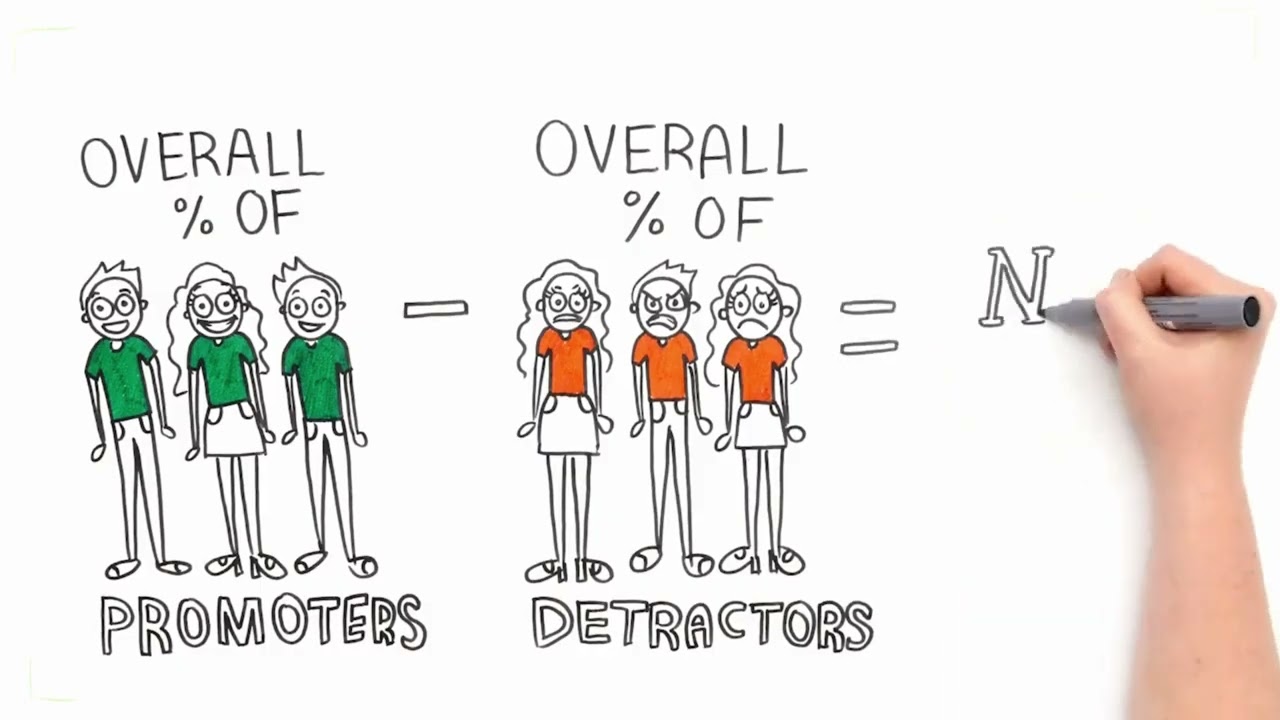
Bain & Company defines the bands: ratings of 9 or 10 are promoters, 7 and 8 are passives, and 0 through 6 are detractors. The Net Promoter Score is the percentage of promoters minus the percentage of detractors (Bain & Company). With 60% promoters, 30% passives and 10% detractors, your NPS is 50.
CES in one line
Customer effort score is a single-item metric that measures how much effort a customer has to exert (Qualtrics). It is most useful for anything with steps: booking an appointment, paying, returning an item.
30+ customer satisfaction survey questions by business type
Pick 3 to 5 from the list that fits you. Do not send them all.
Core questions for any local business
- Overall, how satisfied were you with your visit today? (1 to 5)
- How likely are you to recommend us to a friend or colleague? (0 to 10)
- What is the main reason for your score? (open)
- What is one thing we could do better? (open)
- How would you rate the friendliness of our team? (1 to 5)
- Did you find what you were looking for? (yes or no)
- How likely are you to visit us again? (1 to 5)
Restaurants and cafes
- How satisfied were you with the food? (1 to 5)
- How long did you wait for your table or order? (too long, about right, quick)
- Was your order correct and served at the right temperature? (yes or no)
- How would you rate the atmosphere? (1 to 5)
- How would you rate the value for money? (1 to 5)
- Was your server attentive without being intrusive? (1 to 5)
- What dish would you order again? (open)
If you run a restaurant, our restaurant solution page shows how surveys fit with reviews and loyalty.
Salons, spas and beauty
- Did the result match what you asked for? (1 to 5)
- How comfortable did you feel during the appointment? (1 to 5)
- Did we start on time? (yes or no)
- Did your stylist or therapist explain the options clearly? (1 to 5)
- How easy was it to book? (1 to 7)
- Would you book with the same person again? (yes or no)
Shops and retail
- Was it easy to find what you wanted? (1 to 5)
- Did a team member help you when you needed it? (yes or no)
- How was the checkout experience? (1 to 5)
- Were prices clear and easy to see? (1 to 5)
- Which product were you hoping to find that we did not have? (open)
- How would you rate the store's cleanliness and layout? (1 to 5)
Home services (plumbers, electricians, cleaners)
- Did the technician arrive within the time window we gave you? (yes or no)
- Was the work explained clearly before it started? (1 to 5)
- Was the final price what you expected? (yes or no)
- Was your home left clean and tidy? (1 to 5)
- Was your problem fully solved? (yes or no)
- How easy was it to book and reach us? (1 to 7)
The 3-question survey for a very small business
If you only have a few customers per day, keep it tiny:
- How satisfied were you with your visit today? (1 to 5)
- How likely are you to recommend us? (0 to 10)
- What is one thing we could do better? (open)
Three questions take well under a minute. They give you a CSAT, an NPS and a reason, which is enough to spot a pattern within a month.
How to send the survey and what response to expect
The channel changes how many people answer. SurveyMonkey's 2025 platform data shows email surveys averaging a 49.17% response rate, web link surveys 29.95% and SMS surveys 18.54% (SurveyMonkey).
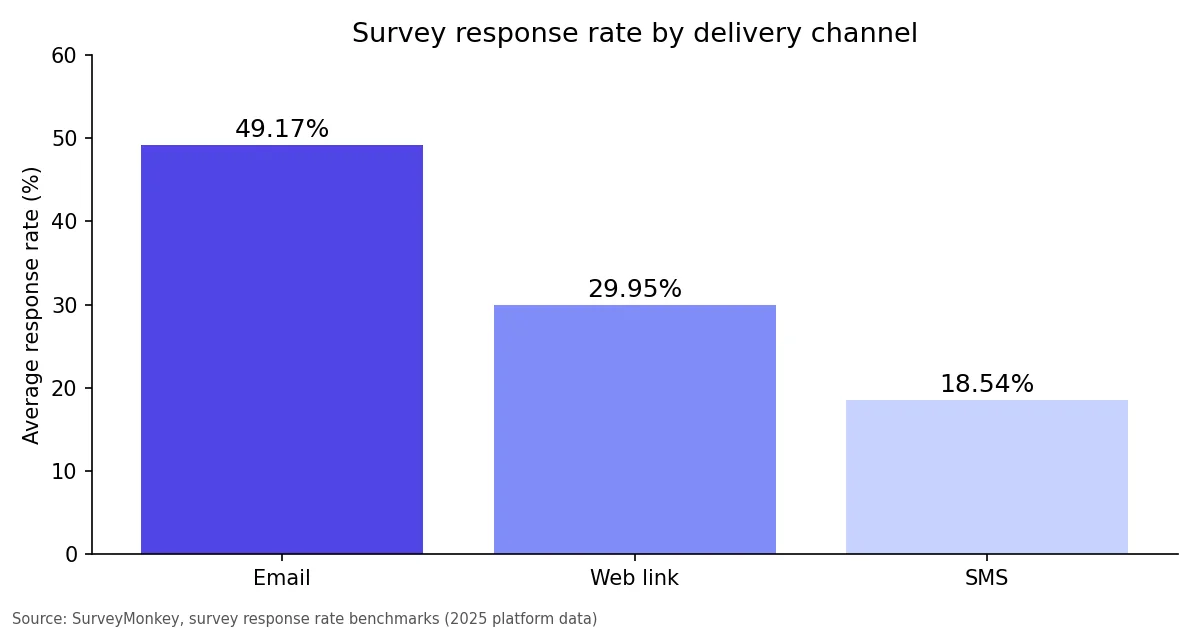
Those are averages across all industries, so treat them as a rough guide. For a local business, the practical options are:
- QR code at the counter or on the receipt. No contact details needed, and it works on the spot. You can generate a QR code that points to your survey.
- SMS after the visit. Short and fast. It suits appointment-based businesses where you already have the number. See how an SMS marketing campaign can carry it.
- Email. The highest response rate in the data above (an average across industries), but only if you collect email addresses at checkout or booking.
Send it within a few hours, while the visit is fresh.
Why a small response rate can mislead you
A survey only tells you what the people who answered think. Bain gives a clear example: with a 20% response rate, a company's respondents produced an NPS of 50, but the true score, once the silent 80% was weighted in, was negative 22 (Bain & Company).
For a small business, that means two habits:
- Compare your score month to month, not against a global benchmark.
- Treat a handful of very low answers as a signal to investigate, not noise.
What to do with the answers
A survey that nobody reads is worse than no survey. Use a simple routine.
- Call low scores fast. Any 1 to 3 on CSAT, or 0 to 6 on NPS, gets a personal reply, ideally within a day. Apologize, ask what happened, offer a fix.
- Read every open comment weekly. Group them by theme: wait time, price, cleanliness, staff. The top theme is your next improvement.
- Thank happy customers and invite them to review you. BrightLocal found that 74% of consumers look for reviews written in the last three months, and 80% say they are likely to use a business that responds to all of its reviews (BrightLocal). Fresh public reviews matter, and you can read our guide to collecting more customer reviews.
- Track CSAT and NPS monthly. One line in a spreadsheet is enough.
Do not filter who can review you on Google
It is tempting to send only the happy respondents to Google. Do not. Google's contribution policy asks businesses not to selectively solicit positive reviews (Maps User Generated Content Policy Help). Use the survey to fix problems privately, and invite every customer to share a public review.
How Up Review handles satisfaction surveys
Up Review includes NPS and CSAT surveys in its Signature pack. You can send them by SMS, email or QR code, follow results in a satisfaction dashboard, and spot unhappy customers so you can follow up with them. Surveys sit alongside Google review management in the same platform. See the satisfaction survey page for details and the pricing page for packs. A demo takes 30 minutes.
Customer satisfaction survey template you can copy
Paste this into any form tool, or use it as your script at the counter.
- Overall, how satisfied were you with your visit today? (1 to 5)
- How likely are you to recommend us to a friend or colleague? (0 to 10)
- What is the main reason for your score? (open)
- Anything we could do better? (open, optional)
Add one business-specific question from the lists above if you want, and stop there.