A customer is torn between your table and the one across the street. Before even glancing at your menu, they open Google and read your rating.
That has become the first reflex, and it often decides for them. For a restaurant owner, knowing how to manage your Google reviews is no longer optional: it is what fills the dining room or leaves it empty. It is also one of the most effective ways to attract more customers to your restaurant.
👉 Here is how to get more of them, respond to them, and turn your reviews into customers.

Why Google reviews have become the number one factor in choosing a restaurant
Google reviews have become the top decision factor because your future customers trust them more than they trust your own advertising.
A Google review is a public rating left by a customer on your Google Business Profile: a rating from 1 to 5 stars, often paired with a written comment. It is word-of-mouth gone digital: the voice of a stranger who has already tried your restaurant, and it carries real weight in how people choose where to eat.
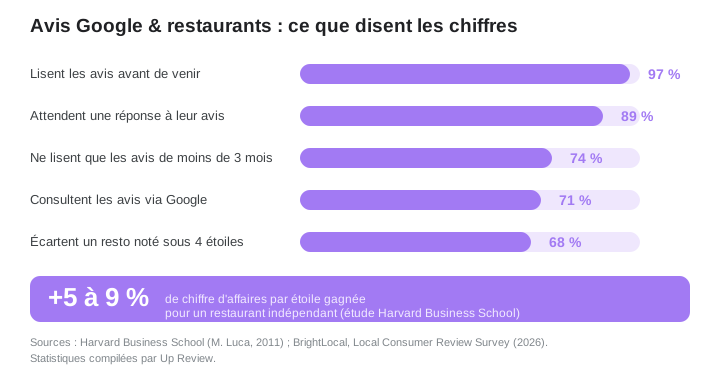
Today, 97% of consumers check online reviews before choosing a local business, and Google remains by far the number one source they check ( BrightLocal, Local Consumer Review Survey, 2026. ). When someone searches for a place to eat, Google reviews are what show up first, well before your website.
Your online reputation has become the entry filter for your restaurant. And that filter is a demanding one: a significant share of customers automatically rule out any restaurant rated below 4 stars. Your online reputation is no longer decided only in the dining room, but on your Google profile too.
Google reviews and your local SEO
Google wants to send its users to the best businesses. To rank them, it looks closely at your reviews: how many you have, how recent they are, your rating, and whether you respond to them or not.
It is a direct lever for local SEO. Review signals account for roughly 16% of the ranking in the Local Pack, the three results Google highlights on the map at the top of the page ( Whitespark, Local Search Ranking Factors, 2026. ). A restaurant that collects recent reviews and responds to them comes across as active and popular; Google can then push it higher.
The stakes are huge once you consider that the top result alone captures around 27% of clicks ( Backlinko, Google CTR Stats, 2023. ). In a competitive area, picture ten similar restaurants, say one Italian place per neighbourhood: the quality of your reviews is often what puts you ahead. The same holds for classic organic SEO, since an active profile feeds your restaurant's visibility on Google as a whole.
Google reviews and Google Maps
Google Maps has become the GPS for choosing where to eat. Tourists and locals alike type "restaurant" and compare ratings within seconds.
Your reviews directly shape your ranking among the restaurant Google reviews shown in Maps. The more positive, recent reviews you have, the higher you appear when someone searches nearby. It is a shop window open 24/7, and it can bring in more local customers without spending a single euro on advertising.
The starting point is always your Google Business Profile, formerly known as Google My Business. That is where everything happens: your opening hours, your photos, and above all your restaurant's reviews. If you have not claimed your Google My Business page yet, that is the very first thing to do.

Google reviews and your revenue
This is where it gets concrete. A landmark study found that one extra star on an independent restaurant's rating can generate 5 to 9% more revenue ( Michael Luca, Reviews, Reputation, and Revenue: The Case of Yelp.com, Harvard Business School, 2011. ).
Put plainly: for a busy restaurant, that adds up to tens of thousands of euros a year. Your reviews are not just about image, they represent potential customers who either push open your door, or walk on by.
And the mechanism is simple. A good rating reassures, review volume builds credibility, and your responses show that you listen. Three signals that turn a curious browser into a booking.
How to get more Google reviews for your restaurant
The best way to get more Google reviews is simply to ask for them, at the right moment and with zero friction. Your satisfied customers almost never think to leave a review on their own; unhappy ones, on the other hand, usually do. So you need to actively rebalance the scales.
Here are the main channels for collecting reviews, ranked from most powerful to simplest.
| Collection channel | Effectiveness | Best for | Customer friction |
|---|---|---|---|
| Prize game | ★★★★★ | Maximising review volume | 1 scan + game (under 30 s) |
| NFC plate | ★★★★ | Table service | 1 tap, no contact needed |
| QR code on the table | ★★★ | Every restaurant | 3 to 4 taps |
| Post-visit SMS | ★★★ | Already loyal customers | Direct link |
| Post-visit email | ★★ | Online bookings | Direct link |
| Verbal request | ★★ | End of the meal | Variable |
The prize game: the most powerful lever
It is by far the most effective method, and it is Up Review's core business. The idea is simple: the customer scans a QR code, tries their luck on a game, like a spin-to-win wheel or a scratch card, and wins a small reward. In exchange, they leave a review in under 30 seconds.
Why does it work so well? Because the game removes the main barrier: motivation. A customer is far more willing to leave a review when there is a chance to win something, all within a legal framework, never making the reward conditional on a positive rating. The result: significantly more reviews, plus a richer customer database along the way for your future campaigns.
It is the tool that turns a trickle of reviews into a steady flow. Discover how it works on our prize game to boost Google reviews page.
Our client Quick Avignon/Nîmes used this exact collection method across three restaurants and moved its average rating from 2.3 to 4 stars.
Create your direct link to your Google reviews
From your profile, generate a direct link to your reviews that takes the customer straight to the "write a review" page, without them having to search for your name. Fewer clicks means more reviews.
This direct link to your Google reviews is the basic building block for everything else: it is what you will turn into a QR code, an SMS, or an email.
The table QR code: the simplest method
Turn your link into a QR code and place it wherever the customer already has their phone in hand: on the table, on the bill, near the till. One scan, and they can leave a review in seconds.
The trick that changes everything: stick your QR codes in strategic spots like the corner of the table, the counter, and even the restroom doors. The more visible the code, the more it gets scanned.

The NFC plate to remove friction
The QR code has one limitation: it still takes a few steps. The NFC plate goes further. The customer taps their phone near it, and the "leave a review" page opens on its own. Zero apps to open, zero searching.
It is the ideal tool for table service: your staff holds out the plate, the customer taps, and it is done. Discover how it works on our NFC Google review plate page.
SMS and email to follow up after the visit
If you collect your customers' contact details, whether through bookings or a loyalty programme, a follow-up the next day is remarkably effective. A short, warm message with the direct link turns a good memory into a Google review.
SMS delivers the best open rates, while email allows for more detailed messages. Ideally, you can automate these sends without mistakenly reaching out to a disappointed customer.
Train your team to ask for reviews
No tool replaces a human request. One sentence is enough, at the moment you bring the bill: "If you had a great time, a Google review would really help us." It is simple, sincere, and it works better than any automated follow-up.
The secret is consistency. Coach your staff through it, give them a short script, and turn it into an end-of-meal reflex.
How to respond to your restaurant's Google reviews
Respond to all your reviews, positive and negative alike, ideally within 72 hours. It is one of the most profitable rules out there: 89% of customers expect a response to their review, and responding sends Google a signal of activity that the local algorithm rewards.
The good news is that responding is also an SEO lever: your replies are read by the algorithm and by future customers alike. It is a genuine customer relationship space in its own right.
How to respond to positive reviews
Do not settle for a copy-pasted "Thank you!". Responding to positive reviews is a chance to build loyalty and naturally slip in your restaurant's name, your neighbourhood, or a signature dish.
Thank the customer by first name, reference a detail from their review, and invite them back to try something new. Since they get a notification, it reopens the door to a next visit.
How to respond to a negative review
A well-handled negative review is worth more than a perfect rating with no comments at all. Customers read the responses: seeing a restaurant owner handle criticism calmly is reassuring. A good response can turn criticism into proof of professionalism.
The structure that works, in four steps:
- Thank the customer for the feedback, even if the review feels unfair.
- Offer a sincere apology and acknowledge the issue, without making excuses.
- Offer a solution publicly, such as a goodwill gesture or an invitation to come back.
- Move to a private channel to sort out the details, through a direct message or direct contact.
What you should never do: respond in the heat of the moment, publicly dispute the customer's legitimacy, or ignore the review. Silence reads as indifference. Always stay courteous, it is simply an extension of your welcome in the dining room. Need templates? Here is how to respond to a negative review, with ready-to-adapt examples.
The Up Review tip: prepare 2 to 3 response templates for positive, negative and mixed reviews, then personalise each one. You save time without sounding generic.
Fake reviews and negative reviews: what to do (and what is off-limits)
No, you cannot delete a negative review or a fake review yourself.
But you have two options:
- Flagging it
- Responding to it
For the full step-by-step process, follow our guide on how to delete a Google review.
If a review is clearly fraudulent, for example from a bot, a competitor, an unhappy customer of a different business, or someone acting in bad faith, flag it. On your Google Business Profile, click "more" then "report as inappropriate". Google's teams then rule on it according to their own guidelines; the moderation effort is real, since Google blocked or removed more than 240 million policy-violating reviews in 2024 ( Google, Transparency Report, 2024. ).
If the review stays online, respond to it factually. For a defamatory review or one that clearly does not add up, like a dish that is no longer on the menu or a suspicious Google account, calmly point out the inconsistency: that is often enough to reassure other readers.
Watch out for this trap: do not go hunting down every negative comment. Trying to get a legitimate comment removed can get you penalised. And never buy fake reviews: fabricated verified reviews get caught quickly, and the penalty is severe. A few negative reviews handled with confidence inspire more trust than suspiciously flawless perfection.
Finally, your negative reviews and comments are an operational goldmine. If the same complaints keep coming up, wait times, customer experience, cleanliness, that is a signal to adjust your service. Customer satisfaction gets fixed in the kitchen and the dining room, not just in your replies.
Up Review: collect and manage your Google reviews without losing your evenings

Everything above works, but it takes time, the scarcest resource when you are running a service. That is exactly the problem Up Review solves.
Up Review is a French solution that helps restaurant owners collect more reviews and manage them all in one place:
- Multi-channel collection: QR code, contactless NFC plate, automated SMS and email, and a prize game.
- AI-assisted responses that match your tone and include your local keywords, letting you respond to reviews in seconds.
- Online reputation tracking: average rating, volume, response time, all monitored in one simple view.
Whether you run an independent restaurant or a multi-site chain, the idea is the same: turn your restaurant's reviews into visibility and covers. To see it in action, explore our AI-powered Google review management solution.
Conclusion: your Google reviews, your best salesperson
Your customer reviews are not another chore, they are your most effective salesperson: they work for you 24/7, on Google and on Google Maps alike. A steady flow of reviews, a solid rating and carefully written responses are enough to make the difference with the restaurant across the street.
Start small this week: create your direct link, put a QR code at three touchpoints, and block out 15 minutes to respond to your latest reviews. Consistency matters more than perfection.