
An empty slot costs you the same whether the customer forgot or simply did not bother. Often they simply forgot. Appointment reminder text messages fix the forgetting part, and once you have your templates they are quick to run. This guide gives you the templates, the timing, the evidence and the consent basics for the US and the UK.
Do appointment reminder texts really cut no-shows?
Yes, with honest limits. The strongest source is a Cochrane review of 8 randomized trials with 6,615 participants. Published in 2013, it concludes that mobile phone text message reminders increase attendance at healthcare appointments compared with no reminder. Pooling 7 studies and 5,841 participants, the risk ratio for attending was 1.14 (95% confidence interval 1.03 to 1.26). The authors rate the evidence as low to moderate quality, so treat it as a solid signal, not a guarantee. All of this evidence comes from healthcare settings.
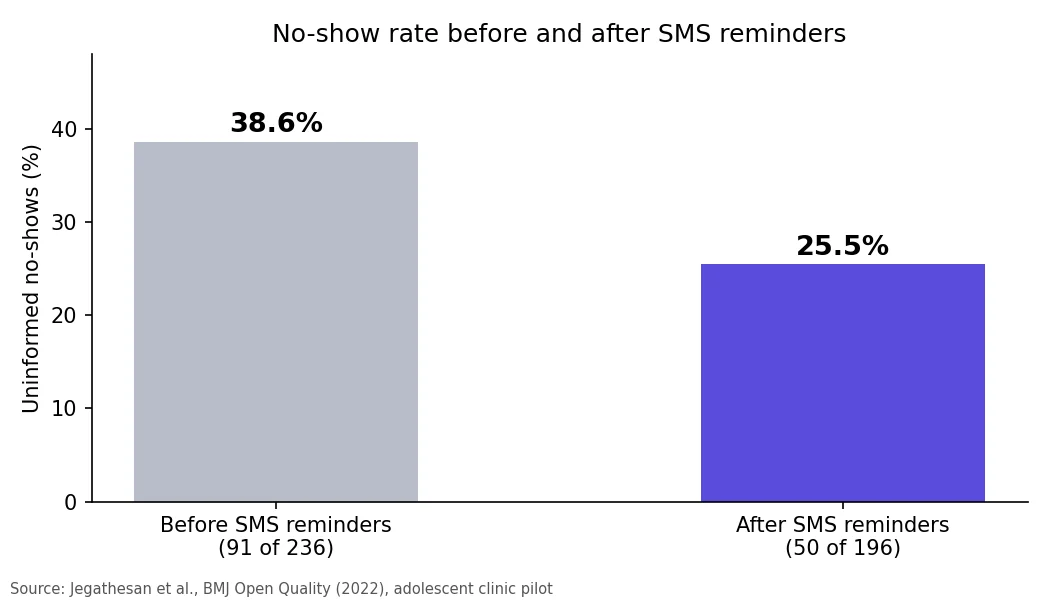
A smaller, more recent example comes from a clinic pilot published in BMJ Open Quality. Before SMS reminders, 91 of 236 appointments (38.6%) were uninformed no-shows. After, 50 of 196 (25.5%) were. The authors report the drop as statistically significant. It was one adolescent clinic and a retrospective comparison, so do not expect the same numbers in a barber shop.
A 2011 review of 29 studies by Hasvold and Wootton found that reminders cut non-attendance by a weighted mean of 34% of the baseline rate. Automated reminders gave a 29% relative change against 39% for manual calls, so a phone call can work a little better. The authors put the cost of a reminder at about 0.41 euros, which suggests, and this is our reading, not the authors', that automation gives a small team most of the effect without someone calling. Their data also comes from healthcare.
Automate the reminder instead of typing it. Sending each text by hand the day before works until the week gets busy. With Up Review SMS campaigns, you save your templates once and the automations send the reminder at the right time from your customer base, with consent tracked in the CRM. Text messages are still the channel people actually open, which is why reminders belong there.
What should an appointment reminder text say?
Keep it boring and clear. Customers should understand it in two seconds. Every reminder needs five things:
- Who you are (the business name, as the customer knows it)
- The date and the time
- Where, as an address or a map link
- One way to confirm, cancel or reschedule
- An opt-out line, such as "Reply STOP to opt out"
Aim for 160 characters or fewer so the message stays a single text. Do not add a promotion. Do not use all caps.
Appointment reminder text templates you can copy
Replace the brackets with your details. Each template works for the first reminder (two days before) or the second (the same day).
| Business | Template |
|---|---|
| Hair salon | Hi [Name], this is [Salon]. Reminder: your cut is [Day] at [Time]. Reply C to confirm or R to reschedule. Reply STOP to opt out. |
| Dental or medical clinic | [Clinic] reminder: [Name], you have an appointment on [Date] at [Time]. Reply C to confirm or call [Number] to change it. Reply STOP to opt out. |
| Auto repair shop | [Garage]: your car is booked for [Day] at [Time]. Please drop it off by [Time]. Need to move it? Reply R. Reply STOP to opt out. |
| Massage or beauty studio | Hi [Name], see you [Day] at [Time] at [Studio], [Address]. Reply C to confirm. 24 hours' notice to cancel, please. Reply STOP to opt out. |
| Restaurant reservation | [Restaurant]: your table for [Number] is booked for [Day] at [Time]. Reply C to confirm or R to change. Reply STOP to opt out. |
Add a link for cancellations if your booking tool provides one, so you hear about changes early. Only use reply words such as C or R if your tool can handle the replies. Otherwise point to a phone number or a link. US clinics should also keep the message minimal and leave out the reason for the visit.
When to send appointment reminder texts
We found no study that settles the best hour, so start with a simple plan and test it:
- Two days before. This gives the customer time to reschedule, and gives you time to refill the slot.
- Two to three hours before. This catches people who simply forgot.
Send during normal waking hours in the customer's time zone. If your tool lets you, skip the second message when the customer has already confirmed the first one.
Do not stack three or four reminders. It is more likely to annoy customers than to help.
Consent and compliance basics (US and UK)
This is general information, not legal advice. Check the rules for your state or country before you send.
United States. The Telephone Consumer Protection Act rules in 47 CFR 64.1200 require prior express consent for autodialed or prerecorded calls and texts to cell phones, outside of emergencies. Marketing messages need a stricter, written form of consent. A called party may revoke consent, and the rule treats a reply of "stop" as a reasonable way to do so. Healthcare providers have an exemption for certain messages, including appointment reminders, but it comes with several conditions, among them a limit of one message per day and three per week, no charge to the recipient, and honoring opt-outs right away. Read the exact text before you rely on it.
United Kingdom. Under PECR, the ICO says you must not send marketing emails or texts to individuals without specific consent. There is a soft opt-in for existing customers, but only when they were given a clear chance to opt out when you collected their details and in every message. A plain reminder about a booking is generally treated as a service message rather than marketing, but adding an offer may turn it into marketing. If in doubt, check the ICO guidance.
The practical habit is similar on both sides of the Atlantic. Collect the phone number with a clear note that you will text reminders, honor "STOP" immediately, and keep promotions out of the reminder.
Pair reminders with missed call text back
Reminders protect the slots that are already booked. They do nothing for the customer who calls while you are busy and gets no answer. That caller may well ring a competitor next.
Missed call text back sends an automatic text to that caller, with a link to book. Up Review's missed call feature does this: when the call goes unanswered, the caller gets an SMS with the link you chose, such as your booking page. That product page also mentions appointment confirmation and reminder texts, so ask what is available on your plan. Together, missed call recovery and reminders cover both ends of the calendar: fill it, then protect it.
If you also want to send campaigns to customers who opted in, see our guide to bulk SMS marketing and these SMS marketing campaign examples. Up Review's SMS marketing campaigns handle the sending side. You can book a 30-minute demo to see how the pieces fit.
Common mistakes to avoid
- Sending without consent. Add a line on your booking form or at the counter.
- Forgetting the opt-out. Always include "Reply STOP".
- Mixing in a sale. Keep reminders and promotions separate.
- No way to reply. A reminder with a confirm word beats a one-way notice.
- Ignoring replies. Someone has to read "can we move it?" the same day.
A quick video

Where to go next
Reminders cut no-shows. Reviews bring in the next customers. Once the appointment goes well, ask for a Google review while it is fresh. Our guide to collecting more customer reviews shows how.
Reminders that send themselves
Up Review sends your appointment reminders and missed-call texts from your CRM, with your templates. 30-minute demo.