
A local business needs a short list of review sites, not a long one. Own your Google profile, add the one or two sites your sector relies on, and follow each platform's rules on asking for reviews. This guide shows which review sites matter for US and UK businesses, which ones fit which sector, and where the rules differ.
Why the choice of review sites matters
Shoppers do not read reviews in one place. According to the BrightLocal Local Consumer Review Survey 2026, 97% of consumers read reviews for local businesses, and the average consumer uses 6 review sites. Google remains the main one: 71% of consumers use it to read reviews, down from 83% the year before, while Apple Maps climbed from 14% to 27%.
Writing tells the same story. The same survey asked where consumers wrote a review in the past year:
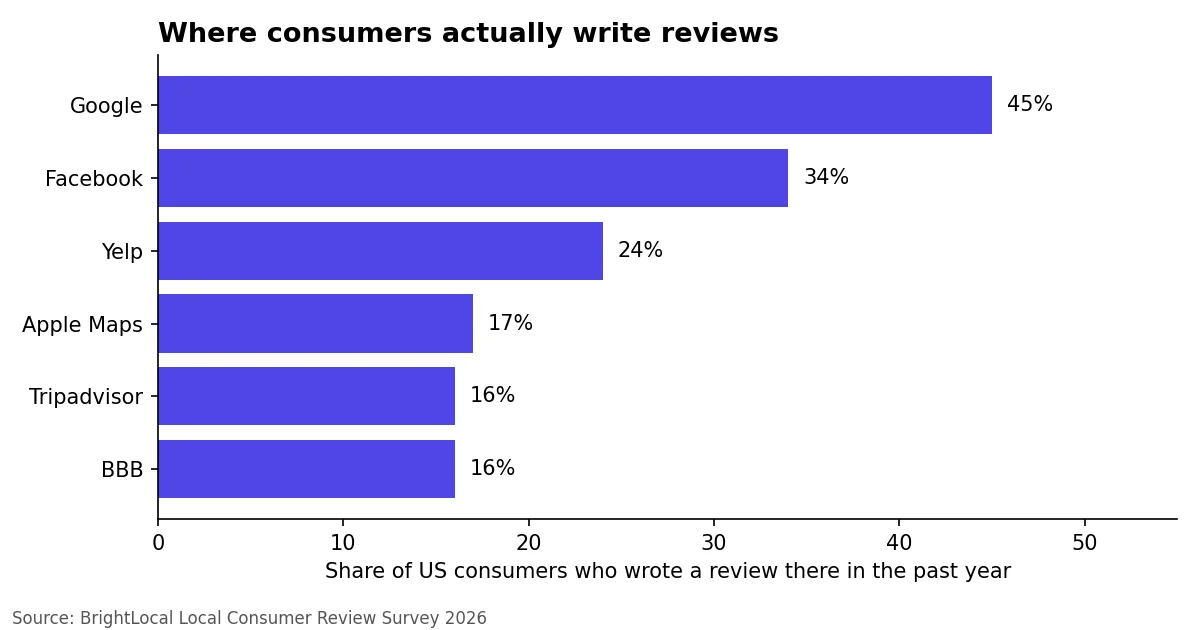
Google leads by a wide margin. That is why, for almost every local business, the first review site to manage is the Google Business Profile. Reviews also matter for visibility: in the Whitespark 2026 Local Search Ranking Factors, a high star rating is ranked sixth among local pack factors, and the number of native Google reviews is ranked ninth. These are expert opinions, not an official Google weighting.
The bar also keeps rising. In the same 2026 survey, 68% of consumers require at least four stars (55% in 2025), and 47% will not use a business with fewer than 20 reviews.
The main review sites, and what each one is for
Here is a quick map of the platforms you will meet most often. The table shows what each is best known for and what to do about it.
| Platform | Strongest for | What a business should do |
|---|---|---|
| Google Business Profile | Every local business | Claim, verify, keep information current, ask for reviews and reply |
| Community and service businesses | Keep the page accurate and reply to recommendations | |
| Yelp | Restaurants, salons, local services (strongest in the US) | Claim the page, reply, do not solicit reviews |
| Tripadvisor | Restaurants, hotels, attractions | Claim the listing, reply, check details |
| Apple Maps | iPhone users looking for places nearby | Claim your place and check the details |
| Better Business Bureau (BBB) | Trades, contractors, service providers | Optional, claim to avoid an empty or outdated profile |
| Trustpilot | Online sales and service businesses | Relevant if you sell online, less so for a shop |
Google Business Profile: the one you cannot skip
Google is where most local decisions start, so treat this profile as the main asset. Complete every field, choose your primary category with care (our guide to the Google Business Profile categories list explains how), and make asking for a review a habit. If you need a link or a QR code to send customers straight to the review form, see how to create and share a Google review link. Not sure where you stand? The free Google Business Profile audit shows what is missing.
Yelp: strong in the US, and strict about asking
Yelp matters most for restaurants, salons and local services, mainly in the US. Its rules are the most unusual. Yelp's business guidance says businesses should not solicit reviews from anyone, including customers, mailing list subscribers, friends and family, and warns that doing so may hurt your rating.
Yelp also runs recommendation software that scores each review on what it calls hundreds of signals of quality, reliability and user activity. Reviews that are not recommended remain viewable through a link but do not count toward your star rating or review count. Yelp states that no employee can override the software's decisions.
In short: claim your Yelp page, reply politely to what is there, and do not run a Yelp review campaign.
Facebook and Apple Maps: easy to forget
Facebook is the second most used platform for writing reviews, so a neglected page costs you. Keep your hours, address and phone number correct and answer recommendations. Apple Maps is the fastest-growing place to read reviews in the BrightLocal data, so check that your business appears correctly there too. For a wider tour of directories that keep your name, address and phone number consistent, read our guide to free business listing directories in the USA.
Tripadvisor, BBB and Trustpilot: only if your sector fits
Tripadvisor is essential for restaurants, hotels and attractions. If you run a restaurant, our guide to Google reviews for restaurants shows how Google and Tripadvisor fit together. BBB is worth claiming if you are a contractor or service provider, mostly so that nobody else defines your profile. Trustpilot suits businesses that sell online (see our Trustpilot alternative guide if you are weighing it up). For a local shop it rarely drives walk-ins, so check what your own customers actually use before investing time.
Review sites by sector
The right shortlist depends on what you sell. This table gives a sensible starting point for the US and the UK.
| Sector | Start with | Then add |
|---|---|---|
| Restaurant, cafe, bar | Google, Tripadvisor | Yelp (US), Facebook |
| Hair, beauty, wellness | Google, Facebook | Yelp (US), booking platform reviews |
| Home services (plumber, electrician, builder) | Google, a trades marketplace (Angi in the US, Checkatrade in the UK) | Facebook, BBB (US) |
| Hotel, B&B, attraction | Google, Tripadvisor | |
| Retail shop | Google, Facebook | Apple Maps, Yelp (US) |
| Health, dental, optician | Facebook, sector directories | |
| Online store or service | Google, Trustpilot | Sector comparison sites |
In the US, home service marketplaces such as Angi and Thumbtack also host reviews, and some run on paid lead models. In the UK, Checkatrade and Yell are common places where tradespeople are listed. Check the terms of any marketplace before you pay for leads, and read its review policy. If you are a restaurant owner, our dedicated restaurant guide shows the full toolkit.
The rules: where Google and Yelp disagree
Businesses most often get into trouble here.
Google lets merchants ask for reviews. Its Business Profile help says to share a link or QR code with customers. Its content policy prohibits paying for reviews, offering discounts or freebies in exchange for them, offering incentives to change or remove a review, setting quotas for staff to solicit reviews, and asking for specific review content. It also prohibits discouraging negative reviews or selectively soliciting positive ones.
Yelp says the opposite on the first point: do not ask. Yelp also forbids freebies, discounts or payment for reviews.
The law sits on top of both. In the US, the Federal Trade Commission's consumer reviews and testimonials rule (16 CFR Part 465) took effect on October 21, 2024.
The US rule covers fake or false reviews, incentives conditioned on a particular sentiment, insider reviews without clear disclosure, company-controlled sites posing as independent, review suppression through threats or false accusations, and fake social media indicators.
In the UK, the Digital Markets, Competition and Consumers Act came into force on April 6, 2025. Traders must not commission fake reviews, and review publishers must take appropriate steps to check that reviews are genuine. According to GOV.UK, fines can reach 10% of worldwide turnover.
Four habits keep you within every one of these rules:
- Ask every customer, not only the happy ones.
- Never reward a review for its rating, and read each platform's incentive rules before you offer anything in return for a review.
- Never write or buy reviews, and never ask staff to write them.
- Reply to positive and negative reviews on every site you have claimed.
Our article on encouraging customers to leave reviews goes further on wording and timing.
How to claim and tidy your profiles in one afternoon
You can set up all the sites that matter in a single sitting. Block out a couple of hours and work through this checklist.

- Write down your exact name, address and phone number. Use the same format on every site.
- Claim Google first. Verify the profile, then complete categories, hours, services and photos.
- Search for your business on Facebook, Yelp, Apple Maps and one sector site. Claim what exists, and fix wrong details.
- Upload the same logo and a few real photos. Consistency helps customers recognize you.
- Turn on notifications. You want to know when a new review lands.
- Decide who replies. BrightLocal reports that 89% of consumers expect owners to respond, so name one person and set a time each day.
Make it easier to collect reviews where it counts
Once your profiles are in order, the real work is generating a steady flow of genuine reviews on Google. BrightLocal found that 78% of consumers were asked for a review in the past year, and 65% wrote one after being asked. So asking works, if you do it at the right moment.
We build Up Review, a platform that helps local businesses collect Google reviews in store through a prize game, QR codes and NFC plates, then reply to them and keep the contact details for later campaigns. Whatever tool you use, check each platform's incentive rules before running a game. See how Google reviews management works, try the Google review contest, or compare it with other options in our guide to the best review management software. The pricing page lists the current plans, and a demo takes 30 minutes.